
The teen years are often described as tumultuous, confusing, and emotional—for both teens and their parents. But beneath the eye rolls, slammed doors, and unpredictable moods is something developmentally essential: differentiation.
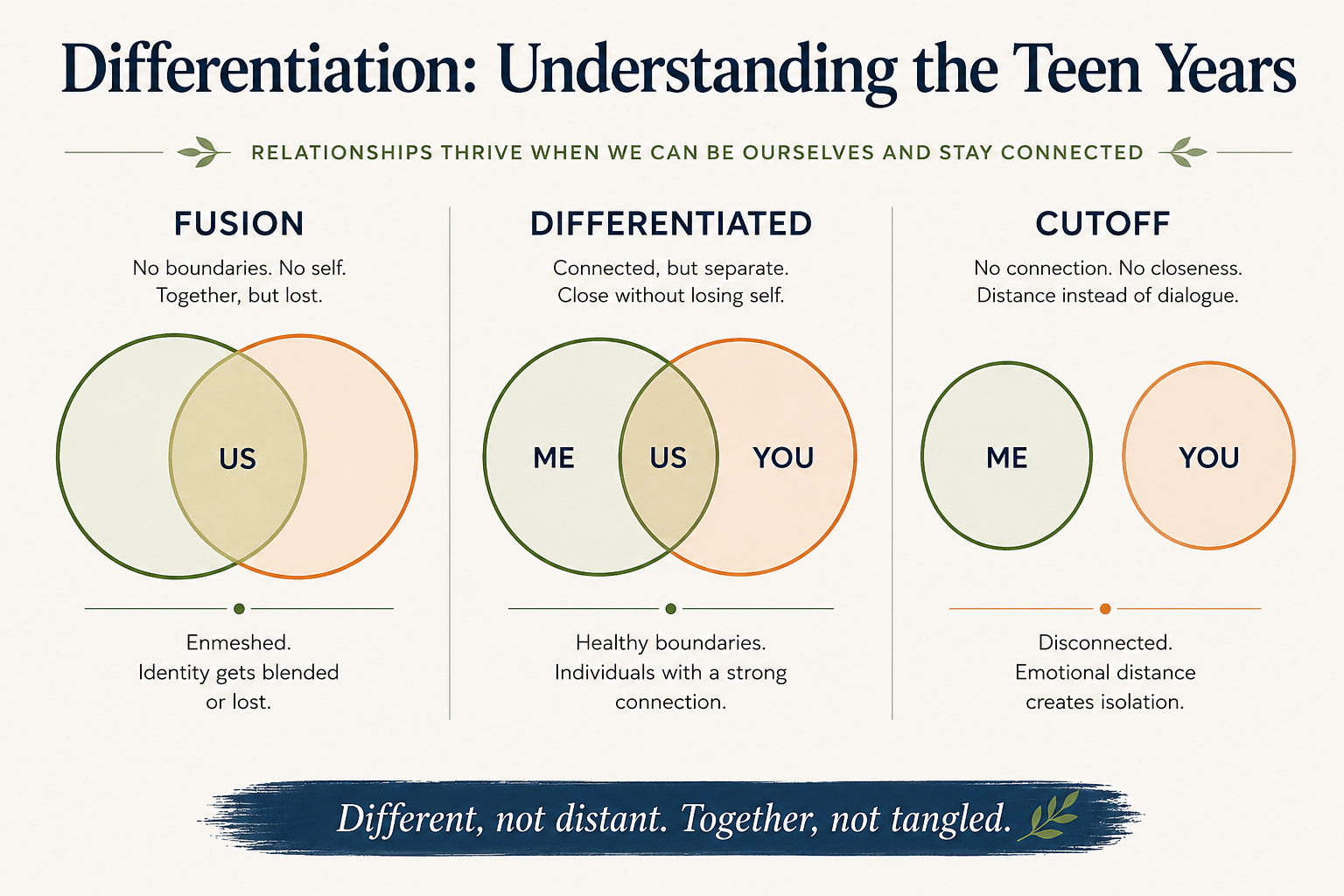
In family systems theory, differentiation refers to a person’s ability to maintain their sense of self while staying connected to others. This concept, developed by Dr. Murray Bowen, is especially critical in adolescence. It’s the developmental task of becoming a separate individual—one with their own opinions, values, and identity—while still being part of a family system.
The Push-Pull of Differentiation
Parents often describe adolescence as a roller coaster. One moment their teen is seeking closeness, the next they’re pushing away. This push-pull is not only normal—it’s necessary. It’s how teens test boundaries, assert autonomy, and gradually prepare for independence.
Think of differentiation as an emotional stretching process. Teens stretch away from their parents to explore who they are, but they need the emotional elasticity of the relationship to safely return. If the relationship snaps under the pressure—through over-control, emotional cut-off, or conflict escalation—both teen and parent lose the opportunity to grow.
Why It’s So Hard (and So Important)
When teens differentiate, they often challenge the values, rules, or roles that have been long accepted in the family. This can feel threatening to parents, who may interpret a teen’s withdrawal or defiance as disrespect, rather than a necessary step toward independence.
Here’s an example: “Lily,” a 15-year-old, began pushing back hard against her family’s religious traditions. Her parents feared she was becoming lost or rebellious. But in sessions, it became clear Lily was trying to figure out what she believed—apart from what she had always been told. Her questioning wasn’t rejection; it was exploration. Once her parents began to listen without reacting, conversations opened up. Their relationship deepened, even as her beliefs became her own.
Healthy differentiation doesn’t mean agreement. It means a teen can hold a different perspective without the relationship falling apart.
Differentiation vs. Emotional Fusion
Families that struggle with differentiation often lean into one of two extremes:
Fusion: Everyone is emotionally entangled. Dissent is seen as betrayal. There’s pressure to conform.
Cutoff: Emotional distance becomes the norm. Conflict is avoided through silence or detachment.
Neither extreme supports long-term relational health. Differentiation, on the other hand, allows for closeness without enmeshment—and distance without disconnection.
How to Support Differentiation as a Parent
Listen more than you lecture
When your teen pushes back, try to get curious before you correct. Ask open-ended questions. Let them hear their own thoughts out loud.Tolerate discomfort
Watching your teen make different choices—or even mistakes—can be deeply uncomfortable. But micromanaging erodes trust. Growth requires room to stumble.Model differentiation
Show your teen how to respectfully disagree, hold your own values, and repair ruptures. Your self-regulation teaches them theirs.Set boundaries without controlling
Teens still need structure—but it should evolve with their maturity. Involve them in setting limits. Focus on mutual respect rather than obedience.Don’t confuse differentiation with disrespect
A teen expressing strong feelings, opinions, or identity isn’t necessarily being defiant. Often, they’re learning to think for themselves.
A Systemic Lens on the Teen Years
Differentiation doesn’t happen in isolation. A teen’s journey toward selfhood is deeply influenced by their family environment. If a system is reactive or rigid, it can shut down the differentiation process. If the system is flexible and open, it can help teens grow into confident, independent adults.
That means part of your teen’s growth depends on your own. Ask yourself:
Can I stay calm when my teen challenges me?
Can I stay connected even when we disagree?
Can I reflect on what’s mine to carry—and what’s theirs?
Differentiation is a two-way street. As our children grow, we must grow with them.
A Final Reflection
Adolescence is not about rebellion—it’s about emergence. Your teen isn’t trying to pull away from you—they’re trying to step into themselves.
This week, notice where you’re reacting versus responding to your teen’s efforts to assert themselves. What might shift if you approached the moment with curiosity rather than control?
The more you support healthy differentiation, the more likely your teen is to stay emotionally connected—even as they grow into the adult they’re meant to become.
